
Assessing Organizational Resilience: The Departmental Fragility Index (DFI)
April 10, 2026
The analytical engine and anonymized datasets discussed below, as well as a project Wiki, are available on the Open Science Framework: OSF Project Repository
In the strategic management of academic institutions, significant emphasis is placed on "high-impact faculty"—individuals whose contributions to research output, extramural funding, and disciplinary prestige are substantial. However, from an organizational risk perspective, these critical contributors can also represent a significant structural vulnerability.
Academic Analytics Research Center (AARC), in collaboration with our Senior Advisors, has developed a Departmental Fragility Index (DFI) as an attempt to quantify these vulnerabilities. The DFI represents a transition from a focus on individual performance metrics to a broader emphasis on structural network resilience.
Defining Departmental Fragility
A department is defined as "fragile" when its scholarly "capital" (e.g., publication prowess, winning grants, honors and awards, etc.) is highly concentrated within a small subset of its faculty. If a department’s collaborative network or primary funding streams are centralized around a single node, the unit faces significant risk from faculty attrition, whether due to external recruitment or retirement.
The DFI captures this by aggregating data across six distinct pillars, evaluating output concentration, budgetary reliance, retirement risk, and collaborative connectivity.
Methodological Foundation: Structural HHI
The DFI utilizes the Herfindahl-Hirschman Index (HHI) as its primary mathematical engine. Widely used in regulatory economics to assess market competition, the HHI calculates the sum of the squared shares of all participants within a unit.
- High HHI (Centralized): Indicates a "Hub-and-Spoke" structural model, where the department is critically dependent on a central node.
- Low HHI (Decentralized): Indicates a "Distributed Mesh" model, reflecting a resilient organization where talent and collaborative assets are broadly dispersed.
Dynamic Weighting and Disciplinary Normalization
Scholarly productivity is not a monolithic concept; its definition varies significantly across the disciplinary landscape. The DFI utilizes a Dynamic Weighting Rubric to account for these variances.
The model automatically identifies metrics that are irrelevant to a specific discipline. For example, if extramural grants are not a primary performance indicator in a specific field, the "Budgetary Pillar" is mathematically excluded. The final DFI score is then normalized based on the remaining valid metrics, ensuring a balanced 0-to-100 index across all fields of study.
Longitudinal Risk: The Poaching and Sunset Windows
A critical component of the DFI framework is the temporal nature of risk. Faculty attrition risk is not uniform across a career trajectory; we therefore distinguish between two primary categories of vulnerability:
- Systemic Poaching Risk: Evaluates high-velocity, mid-career faculty (0–35 years post-degree) who are primary targets for external recruitment.
- Sunset Risk: Evaluates high-impact faculty nearing the end of their career trajectory, where the risk is driven by imminent retirement rather than recruitment.
By separating these risks, academic leadership can develop targeted retention and succession plans that address the specific structural needs of their departments.
Strategic Implications
Departmental fragility is not a proxy for quality; indeed, many elite departments exhibit high fragility due to the presence of singular, world-leading experts. Rather, the DFI serves as a diagnostic tool for long-term organizational sustainability.
By identifying these structural bottlenecks before an attrition event occurs, provosts and deans can proactively foster a more resilient, distributed model of departmental excellence.
Structural Concentration and the Scale of Research
As we analyze these metrics across the academic landscape, a clear trend emerges regarding departmental scale and the concentration of scholarly assets. When examining the relationship between faculty headcount and the Output HHI, we observe a characteristic "fragility curve."
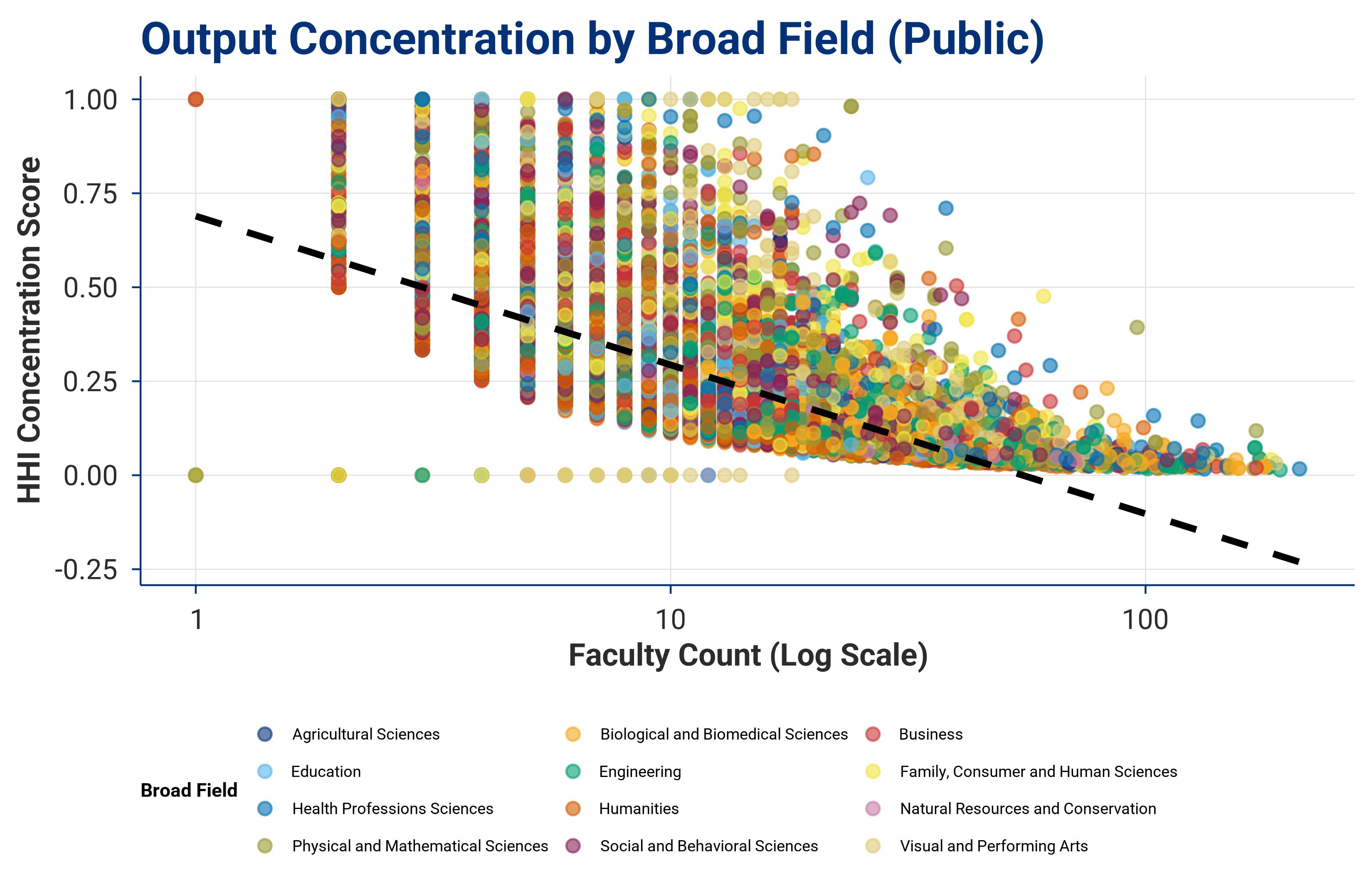
In smaller units, HHI scores tend to be naturally higher and more volatile, as the departure of even a single high-impact researcher can fundamentally shift the department's profile. However, as department size increases, we see a logarithmic decay in concentration—larger departments benefit from "structural insulation," where research footprints are typically more distributed. Nevertheless, significant outliers exist: large departments that maintain high HHI scores remain critically vulnerable despite their size, often indicating a "hub-and-spoke" model that has not yet decentralized as the unit grew.
Defining the Composite DFI
It is important to be explicit about the composition of the final index: the Composite DFI is the normalized average of all underlying fragility pillars (Output Concentration (HHI); Keystone Sensitivity (Jackknife); Budgetary Fragility (Grant HHI); Prestige Fragility (Award HHI); Sunset Risk (Proportional Output); and Collaboration Glue (Synergy HHI)). However, in accordance with our disciplinary weighting rubric, any pillar that does not "count" for a specific field - such as patents in the humanities or books in certain laboratory sciences - is entirely excluded from the calculation. The resulting score is a high-fidelity reflection of structural risk, measured only against the metrics that define success within that specific disciplinary context.
Forward-Looking Remarks
The Departmental Fragility Index marks a shift toward a more nuanced, data-driven understanding of academic sustainability. As we move forward, this framework provides a baseline for "resilience-informed" strategic planning. Rather than viewing faculty attrition as an unpredictable event, provosts and deans can now treat departmental stability as a measurable asset. By fostering environments that encourage broad-based collaboration and a distributed funding base, institutions can ensure that their pursuit of excellence is matched by a commitment to structural permanence.
Project Repository
The analytical engine and anonymized datasets are available for peer review and replication on the Open Science Framework: OSF Project Repository
Citation of the Method and/or Sample Data
Olejniczak, A. J., Powers, J., & Savage, W. (2026). The Departmental Fragility Index (DFI): Assessing Output Concentration and Keystone Reliance. Academic Analytics Research Center (AARC). OSF. https://doi.org/10.17605/OSF.IO/FU6CN