
Tracking 13 Years of Faculty Migration and Attrition
March 4, 2026
Are faculty moving due to state-level political or other pressures more than expected, or is what we observe a standard part of academic career mobility? In a period of intense political polarization and shifting labor markets, understanding the difference between migration (moving to a new university) and attrition (leaving the system entirely) has never been more critical.
Our project, a Faculty Migration and Attrition Study, tracks a specific cohort of faculty members who are active in 2011. By following these individuals through 2023, we uncover a story of systemic departures, geographic anchors, and a "political clock" that does not tick at the same speed for everyone.
The 2011 Cohort: A Survival Story
Instead of looking at the system as a whole, we focus on a "Cohort Survival" logic. We identify every faculty member present in 2011 across 12 broad fields and ask: What happens to them?
Findings #1: The Attrition-Migration Divergence
One of our most striking findings is what we call the Divergence Paradox. Our models show that professional achievement (grants and publications) acts as a "Passport" for migration. If you have the grants, you have the mobility to move to a higher-ranked institution.
However, for women in the academy, the story is different. While women are no more likely to move to a new university than men, they are 11.5% more likely to exit the system entirely.
This suggests that the gender gap is not a "mobility" issue—it is a "survival" issue. The data indicates that women are not being lured away to better academic jobs at higher rates; rather, they are exiting the profession altogether due to cumulative pressures.
Findings #2: The Political "Cross-Over" Effect
Does the state house affect the faculty house? By scraping historical partisan data, we test how "Sustained Trifectas" (three or more years of unified party control) influence retention.
In Republican or Divided states, the gender gap in attrition is a systemic constant. However, in Sustained Democratic states, we observe a "Protective Flip." Women in these environments are actually 6% less likely to leave the academy than the national average. This suggests that state-level policy — such as healthcare access and family leave mandates — acts as a structural buffer for academic careers.
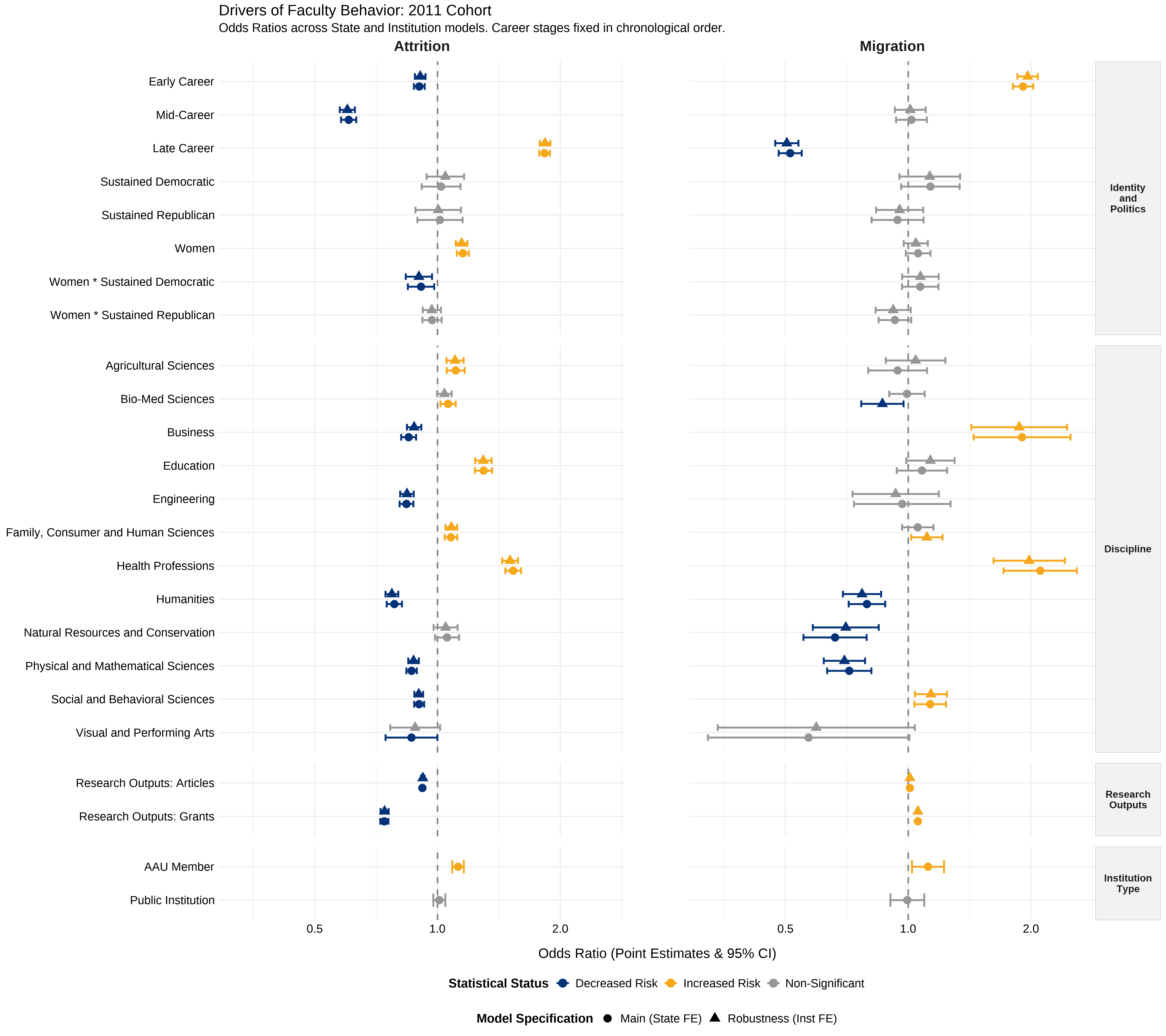
Caption: Forest Plot identifying how different factors, including political environments, moderate the gender gap.
Findings #3: Is it Systemic Attrition or Just Retirement?
Critics often argue that "attrition" is just a synonym for "retirement." To answer this, we implement a Hazard Model to look at the "velocity" of exits.
By calculating the "Cumulative Hazard," we find that while late-career faculty (those over age 65) have the highest baseline risk of leaving (the retirement signal), the "clock" ticks significantly faster for early-career women in certain political climates.
Conclusion: A Profession at a Crossroads
Our data demonstrates that faculty attrition is a policy-sensitive phenomenon. Attrition is highest in fields like Health and Education, while Migration is a phenomenon of the Business school. Most importantly, we show that the "Leaky Pipeline" is not an inevitability — it is a choice influenced by institutional climate and state politics.
As we move into the final phase of our Project, we focus on how institutional prestige (AAU status) and public vs. private funding structures further accelerate or slow down these career clocks.
This study follows AARC SOP-04 Relational Anonymization protocols. All data and scripts are available for verification on our OSF Project page: https://osf.io/kyq2w.